If you consistently seek out the path or least resistance, you will inevitably find yourself at the bottom.
Nielsen Norman Group is a research and consulting firm that was founded by Jakob Nielsen and Don Norman in 1998. On their website, they have a list of clients that they have worked with since that time including companies like Google, Visa, National Geographic and The Smithsonian. In 2006, Nielsen published an article based on study of eye tracking patterns in which he introduced the
"F-Shaped Pattern of Reading the Web." In essence, the F-shape is the result of reading the headline at the top of the page, skimming the left hand side with horizontal movements down the page at points of interest.
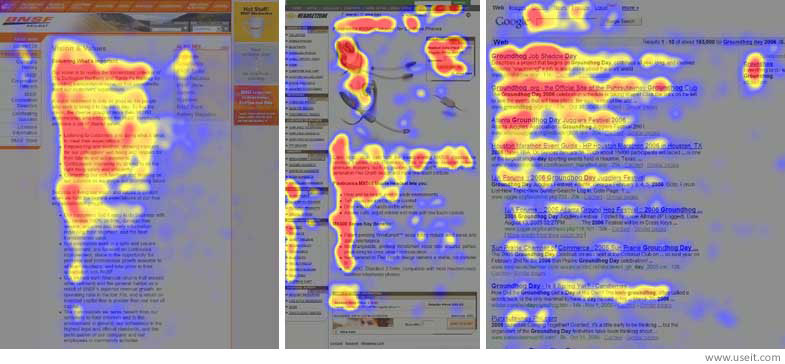
Imagine yourself reading the headline first then skimming the first few words of each paragraph, and stopping briefly on the ones that seem most relevant or interesting. In his article, he implied that readers will not fully read a text, but focus on the the first two paragraphs and sub-headings and bullet point information. Instead of reading for depth, or to gain as much information as possible, readers are usually only looking for a few key ideas and then moving on, usually to post a comment about how much they agreed or disagreed with it.
The F-Shaped pattern of skimming a text is not the only time-saving method that is used when accessing information online. There are several others, including the
layer-cake pattern, spotted pattern, bypassing pattern an others, each designed to help the reader minimize
interaction cost, the sum of efforts required to attain a goal. The driving force behind these patterns is to maximize the potential rewards while expending the least amount of time and energy to do so. It is only the commitment pattern in which an individual exert energy to fixate on all the content and read all of the material presented.
Henry David Thoreau wrote "the cost of a thing is the amount of what I call life which is required to be exchanged for it, immediately or in the long run." Usually, even this quote is ironically truncated into "the price of anything is the amount of life you pay for it." And most, if not all living creatures on this earth are usually trying to minimize this interaction cost, trying to get as much as they can for as little as possible, whether it be time, effort, work, money, or energy.
This is the principle of least effort, and it is a principle of life at almost every level.
When certain cells move through the body, such as white blood cells or metastatic cancer cells, they choose the path of least resistance through the tissue.
Researchers have proven this by placing these mobile cells in a "maze" of different size pours. These cells would test each pour size and then follow the largest of the choices, which would be the easiest to travel through. Researches studying how E. coli adapts to treatment through ampicillin has found that it will evolve and mutate in different ways depending on the concentration of the antibiotic, effectively
choosing the one that requires the least amount of "cost" to the cell to make adaptations to survive.
If something is too complex or has too little reward it is not worth the effort.
-I'm not even going to try to make an origami swan
In the animal kingdom, several animals typify the principal of least effort as a way to survive and thrive in a harsh world. The principle of least effort is about conserving energy or being as efficient as possible.
Examples include spotted turtles who spend winters near the bottoms of ponds and rivers and shunt their blood flow to vital organs, allowing them survive for five months without eating or breathing, penguins who waddle because walking requires too much of the energy that is required to stay warm in freezing temperatures, or
birds and marine animals which use an undulating pattern allowing them to spend large amounts of time coasting downward with little or no effort. These animals are being as efficient as possible with their energy expenditure.
This idea of being as efficient as possible, is not without its danger. Whether viewed as the principal of least effort, or simply being as efficient as possible, this parsimony also removes the benefits of having to adapt through effort. Anthropologists studying the
evolution of two different human ancestors and the development of jaw muscle and tooth structure found that despite having different diets, both developed similar musculature and teeth. The development was sub-optimal for the species, but workable for their diets because it required less adaptation. It wasn't suited for the diet, but good enough without going through the rigors of adaptation.

Similar adaptations, or lack of adaptations have occurred with much more drastic results. These include the vestigulation of certain traits, structures, or behaviors over time when they are not used. This might include the
loss of eyes in certain species of fish through epigenetic adaptation. Simply put, because they did not use their eyes, they eventually disappeared from the species. Another example include
flightless birds who at one point in history were capable of flying, but lost the ability simply because they no longer needed to do it.
When an activity lacks enough challenge, when it crosses the line from engaging to boring, the value that is attached to the reward also also diminishes and the skills or attributes required to accomplish it atrophy. This is why as human beings develop, we usually find less enjoyment in activities that once kept us entertained as children. In video games, once a level is mastered we seek for something more challenging, when we are able to ride a bike with training wheels, we quickly desire to take them off. Yet, when we consistently are faced with activities that require no effort, are too easy, we lose desire to continue with it, even leaving rewards behind. In addition, and even more of a detriment to ourselves, we can also lose the necessary skills or knowledge we gained to become proficient in that specific area. The term commonly used is "rusty."
If something is too easy, we do not feel a sense of accomplishment and are quick to drop it.
-Folding a piece of paper in half is boring so why even practice?
The question of whether these changes are overall net losses, or overall net gains depends on how you assess what is valuable and what is not. For human beings living in today's world, it goes simply beyond a calculation of work versus reward. Optimal happiness, feelings of success, motivational factors and personal choice all play a role in the decision about how much work someone is willing to do for a given result, but never before in history has a species been capable of getting so much "reward" at the expense out of so little work, and we might not fully understand the negative effects.
In 1949, Harvard linguist George Kingsley Zipf
proposed the principle of least effort as it pertained to human language. He posited that language was evolving to become more efficient, using words such as math in place of mathematics or plane in lieu of airplane. Language requires a certain level of complexity to convey the breadth of human thought, but once an abbreviation is understood, it is generally acceptable as a reasonable substitute. Hi, gonna, sup, wanna, etc. The question is at what cost comes this convenience?

In the October 2018 edition of
Trends of Cognitive Science, authors Inzlicht, Shenhave and Olivola published
"The Effort Paradox: Effort is Both Costly and Valued." The manuscript broke down, defined and examined the relationship between effort, motivation, rewards and satisfaction in human behavior. The paradox comes in the acknowledgement that effort is difficult and most are averse to it. When given a choice between exerting effort and not exerting effort for a similar reward, any reasonable person would choose not to put forth any effort. But, effort in and of itself, adds to the reward of an item or process, or sometimes, is the reward itself.
When given a choice between doing nothing and making $100 dollars, and putting forth great effort to make $100 dollars, most would choose to do nothing. But what if it was $100 for nothing, or $120 for something difficult? According to the manuscript, people are often willing to accept fewer rewards to avoid additional effort. Yet ironically, if someone worked for, or did something challenging for that same $100 dollars, they value it much more than the person who did nothing to earn it.
This has been proven by studies in what has become known as the
"IKEA Effect," which is that an individual, when required to work to put something together, values it much more than something that was simply given to them, even the free item has a higher financial cost. The more time and effort someone puts into something, the more they feel accomplished or a sense of self-satisfaction upon completion. This is the basis of why the some of the greatest feelings of accomplishment come not from an event, but in the effort it took to make it to the event. For example, physically standing on a mountain top is not the most rewarding aspect of mountain climbing, it is the effort it took to get there. Had the person flown in a helicopter and landed on the peak, there would be little value beyond the impressive view.
If significant time is put into something, the sense of reward is increased beyond the outcome.
-I'm keeping this origami swan forever because it took me a long time to make
Learned industriousness is the increase of motivation when a reward is increased by the effort it took to achieve. It increases motivation for later and more challenging endeavors. Entitlement is the unreasonable expectation of reward without effort, and it decreases future motivation for more challenging endeavors.
Motivation increases as difficulty and complexity increase, while apathy increases without stimuli forcing change. Worse yet, when indifference is rewarded, it strengthens the aversion towards future activity-- and we live in a world where the effort to achieve has diminished to the point of worthlessness. By making something easier, by giving more reward for less work, we are literally killing any future motivation to work towards greater goals, which is the root cause of entitlement.
If a reward is given for no effort, eventually the reward is seen as worthless.
-I'm just going to throw these origami swans away because I can get another one whenever I want
As technology increases around us, it takes on more of the responsibilities of human survival; things like farming, transportation, manufacturing and other professions. Through automation we will see a diminished need for expending any effort to acquire not only the basics of survival, but the comforts of prosperity as well. It will take less and less effort to maintain a high standard of living, and the value placed on it will depreciate as well. Ready prepared meals delivered to your door, guaranteed incomes, lower standards of excellence, mitigated risks, instant gratification and amusements, or any program or convenience which pushes the boundaries between efficiency of indolence is more likely an unseen expense disguised as a free ride to nowhere. Contentment may soon be wither in the shadow of luxury. Like a fish with no eyes, we may find ourselves blinded by our own progress.
Unlike white blood cells, turtles, or flightless birds, human beings need to do more than "just survive" in order to maintain their overall health and well being. Part of that survival is also a sense of accomplishment, value, contentment and contribution. And, whether we like it or not, those feelings are the result of work put in, of effort, of struggle and facing failure. Understanding that the greatest values of our efforts are not in the getting, but in the earning is hard lesson to learn. It is difficult because like most things in life, the reward can only be found after the price has been paid in full, and taking a short cut only limits the journey.